Syrve Integration
What the AI can do
Summary
Syrve Integration connects Syrve (POS/CRM platform for restaurants and delivery) with Newo Platform.
It enables:
- Creating food delivery orders programmatically through conversational AI
- Checking existing order and delivery status in real-time
- Caching and synchronizing restaurant menus (products, sizes, modifiers, pricing)
- Looking up customers by phone via Syrve loyalty system
- Multi-location order routing via terminal groups
- Fuzzy product matching from cached menu using AKB (Agent Knowledge Base)
This integration is designed for restaurants and food delivery businesses who need automated order taking and status tracking through a conversational AI agent (voice or chat).
Common use cases
- When a customer wants to place a delivery order → AI extracts order details from conversation, matches menu items, creates order in Syrve
- When a customer asks about order status → AI looks up customer by phone, retrieves orders and delivery info
- When a conversation starts → Menu is automatically refreshed if cache is outdated (24h default)
- When a customer mentions a menu item → Fuzzy search matches the item from cached menu with product ID and price
Features at a glance
| Feature | Supported | Notes |
|---|---|---|
| Create Delivery Order | ✅ | LLM payload extraction + fuzzy menu matching |
| Check Order Status | ✅ | By customer phone → order ID → delivery status |
| Menu Synchronization | ✅ | Auto-cache with 24h TTL, products + sizes + modifiers |
| Customer Lookup | ✅ | Via Syrve loyalty by phone number |
| Terminal Group Routing | ✅ | Auto-selects first available terminal group |
| Fuzzy Product Matching | ✅ | AKB-based search, 0.6 threshold |
| Modifier Support | ✅ | Menu cached with modifier groups and prices |
| Order Context Injection | ✅ | Order info injected into prompt after creation |
| Table Reservation | ❌ | Not implemented |
| Payment Processing | ❌ | Not implemented |
| Order Modification | ❌ | Create-only, no edits after submission |
| Multi-Item Orders | ✅ | Supports array of order items |
Before You Start
Before installation:
- Active Syrve account with API access
- Syrve API key (apiLogin credential)
- At least one organization and terminal group configured in Syrve
- Menu/nomenclature populated in Syrve
Setup
Create the Newo project
If this project already exists in Newo Builder, skip this subsection and continue with the integration-specific settings below.
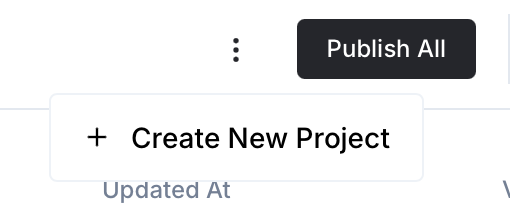
- In Newo Builder, open the projects list and click Create Project (or Create New Project from the top-right menu).
- Fill IDN and Title. The exact names do not matter; use any clear names your team will recognize.
- In Registry, choose the release channel:
- staging — the newest module fixes appear here first. Use it when you need the latest fix, but expect possible unfinished changes.
- production — the final stable version for live projects.
- In Module, select the module for this integration.
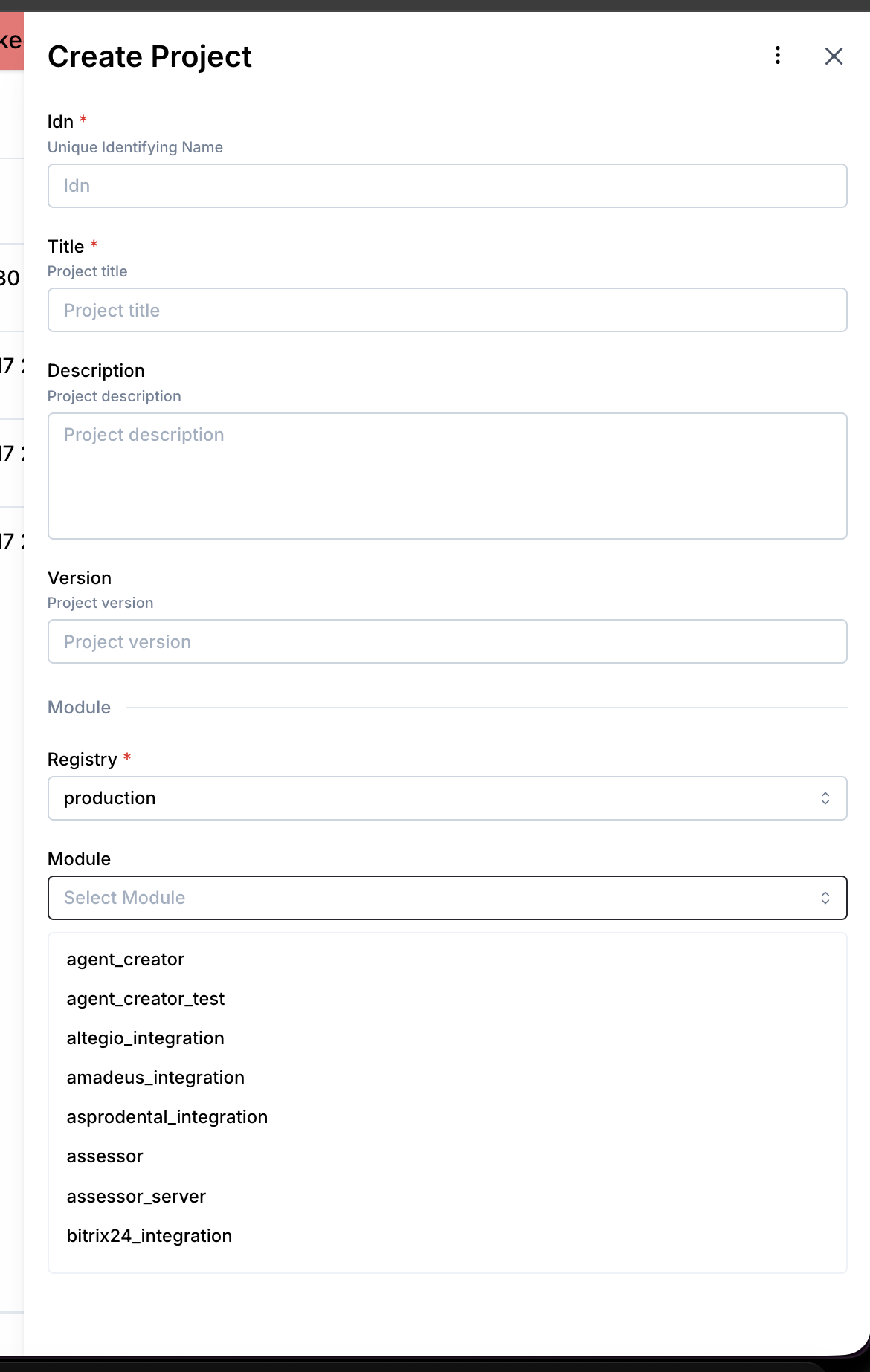 5. Leave Module version on Latest version unless support tells you to pin a specific version, then click Create.
3.1 Step 1 — Get API Key
- Log in to your Syrve management console
- Navigate to API settings and obtain your API key (apiLogin)
- Note the API region (default: EU —
https://api-eu.syrve.live)
3.2 Step 2 — Connect in Platform
- Open Newo → Projects
- Set the following attributes in Builder / Attributes:
| Attribute | Required | Description |
|---|---|---|
syrve_api_key | ✅ | Syrve API key (apiLogin) |
syrve_base_url | ❌ | API base URL (default: https://api-eu.syrve.live) |
syrve_delivery_menu_update_interval | ❌ | Menu cache TTL in seconds (default: 86400 = 24 hours) |
syrve_override_agent_attributes | ❌ | Override SuperAgent attribute schemas (default: True) |
- Click Save + Publish All
- On publish, the SetupFlow automatically:
- Exchanges the API key for an access token
- Discovers the organization ID
- Prepares the connections for API and token operations
- Registers order creation and status check tools with the agent
How to use the integration
This section explains how the integration works, how to configure automation, and how to test it.
4.1 How the Integration Works
The integration uses Syrve's REST API for order management, customer loyalty, and menu data. Orders are created through LLM-powered payload extraction from conversation context, with fuzzy matching against the cached menu. The menu is auto-refreshed on session start when the cache expires.
- A Trigger is a system event that starts a flow
- An Action is the API operation performed in Syrve
Where to test
Testing can be done through the Newo conversation interface (voice or chat). Each flow (CreateOrder, CheckOrders, CollectMenu) has a dedicated webhook test endpoint for connectivity validation.
How to test that everything works
To test the integration:
- Setup: Publish the project and verify token exchange + organization discovery succeeds
- Menu: Start a conversation — verify menu is synced (check
syrve_delivery_menuattribute is populated) - Create Order: Say "I want to order a [menu item] to [address]" — verify order created in Syrve with correct items and pricing
- Check Status: Ask "What's the status of my order?" — verify delivery status returned
If no action occurs:
- Ensure
syrve_api_keyis set correctly - Verify
syrve_access_tokenwas obtained (check it's not empty after setup) - Confirm
syrve_organization_idwas discovered - Check that menu cache is populated (
syrve_delivery_menuis not[]) - Verify the menu was synced to AKB with label
syrve_menu - Re-publish the project if credentials were changed
Note: This integration creates real orders in Syrve. Orders submitted through the agent are sent to the live POS system with
sourceKey: "voice-agent".
FAQ
Q: How does the agent match menu items from conversation?
A: The integration uses a two-step process: (1) LLM extracts the item name from conversation memory, (2) fuzzy AKB search with syrve_menu label matches the name to cached products (threshold: 0.6). The matched product's ID and price are used for the order.
Q: How often is the menu refreshed?
A: By default every 24 hours (syrve_delivery_menu_update_interval = 86400 seconds). The cache is checked on every session_started event. If the timestamp exceeds the TTL, the menu is re-fetched from Syrve's nomenclature API.
Q: What happens if a menu item isn't found?
A: The agent receives a product_not_found error, which it can communicate to the customer. Only items present in the Syrve nomenclature and cached in AKB can be matched.
Q: Does the integration support modifiers (e.g., extra cheese)?
A: The menu cache includes full modifier group data (group names, required/optional flags, min/max counts, individual modifiers with prices). However, the current order creation flow sends an empty modifiers: [] array — modifier selection is not yet implemented in the ordering pipeline.
Q: Which LLM models are used?
A: The primary model is gemini25_flash (Google Gemini 2.5 Flash) for most operations. The CheckOrdersFlow's _getContactSuccessSkill uses gpt4 (OpenAI) — this is the only skill in the integration that uses a different model.
Q: How does multi-location routing work?
A: During order creation, the integration fetches terminal groups for the organization and automatically selects the first available terminal group. The syrve_terminal_group_id is stored and used for order routing.
Q: What customer information is required for ordering? A: First name, phone number (E.164 format), and delivery address are required. Last name is optional — if missing, the first name is copied to the last name field. The phone is used to look up the customer in Syrve's loyalty system.
Q: What is injected into the prompt after order creation?
A: The full orderInfo object from the Syrve API response is injected as a custom prompt section (ExistingOrderInfo role="context"), allowing the agent to reference order details (ID, status, items) in subsequent conversation turns.